Protein sounds straightforward until you try to choose a number. One person says 60 grams, another says 150, and suddenly breakfast feels like a maths problem.
The useful answer is not one number for everyone. Your body size, activity, goal, food preferences, and health all matter. The good news is that you do not need to chase a perfect target to make protein work for you. Start with a sensible reference point, then make it fit the meals you actually eat.
Start with a baseline, not a viral target
For healthy adults, the European Food Safety Authority sets its population reference intake at 0.83 grams of protein per kilogram of body weight per day. You can read the reasoning in its protein dietary reference values.
To turn that into a starting number, multiply your body weight in kilograms by 0.83. A person who weighs 70 kg would land at about 58 grams per day.
That reference is a starting line for general health, not a score to beat and not a personal prescription. Your needs can look different if you train regularly, are intentionally losing weight, are older, are pregnant or breastfeeding, or manage a health condition.
Why your goal can change the conversation
If you do resistance training, protein supports the work you are asking your muscles to do. A large review of protein and resistance training found that the average benefit for lean-mass gains did not keep rising beyond roughly 1.6 grams per kilogram per day. That does not make 1.6 a rule for every person. It does show why someone who trains for strength may set a higher target than the general-health baseline.
The same is true when fat loss is your focus. A protein target can help you build meals around foods that support training and keep your routine steady, but it cannot replace enough food overall, recovery, or a sensible plan.
| Your situation | A useful starting thought | What to prioritise next |
|---|---|---|
| Everyday health | Use 0.83 g per kg as a general reference. | Look at your usual meals before making big changes. |
| Strength training or body recomposition | A consistent target above the baseline may be useful. Around 1.6 g per kg is a research benchmark, not a rule. | Build protein into two or three meals you can repeat. |
| A fat-loss phase | Keep protein deliberately in the plan while your weight changes. | Log real meals, protect recovery, and avoid extreme rules. |
If you are still choosing between a fat-loss, maintenance, or muscle-building phase, our bulk-or-cut article can help you choose the direction first.
Turn a daily number into normal meals
Trying to "catch up" with protein at dinner is usually harder than giving a few meals a clear protein anchor.
Start by looking at a normal day. Which meal already contains a useful protein food? Which meal is mostly coffee, toast, or whatever happened to be available? You do not need to rebuild every meal. Often, one easier breakfast and one reliable lunch make the whole target feel less dramatic.
Some simple anchors are:
- Greek yogurt, cottage cheese, eggs, tofu, or soy yogurt at breakfast;
- beans, lentils, tuna, chicken, tofu, tempeh, fish, or lean meat in a lunch or dinner you already enjoy;
- a protein-rich snack when it genuinely helps you bridge a long afternoon.
The best choices are the ones you can afford, prepare, and want to eat again next week. Protein is part of a meal, not a reason to make every meal look the same.
Animal, vegetarian, and vegan protein sources
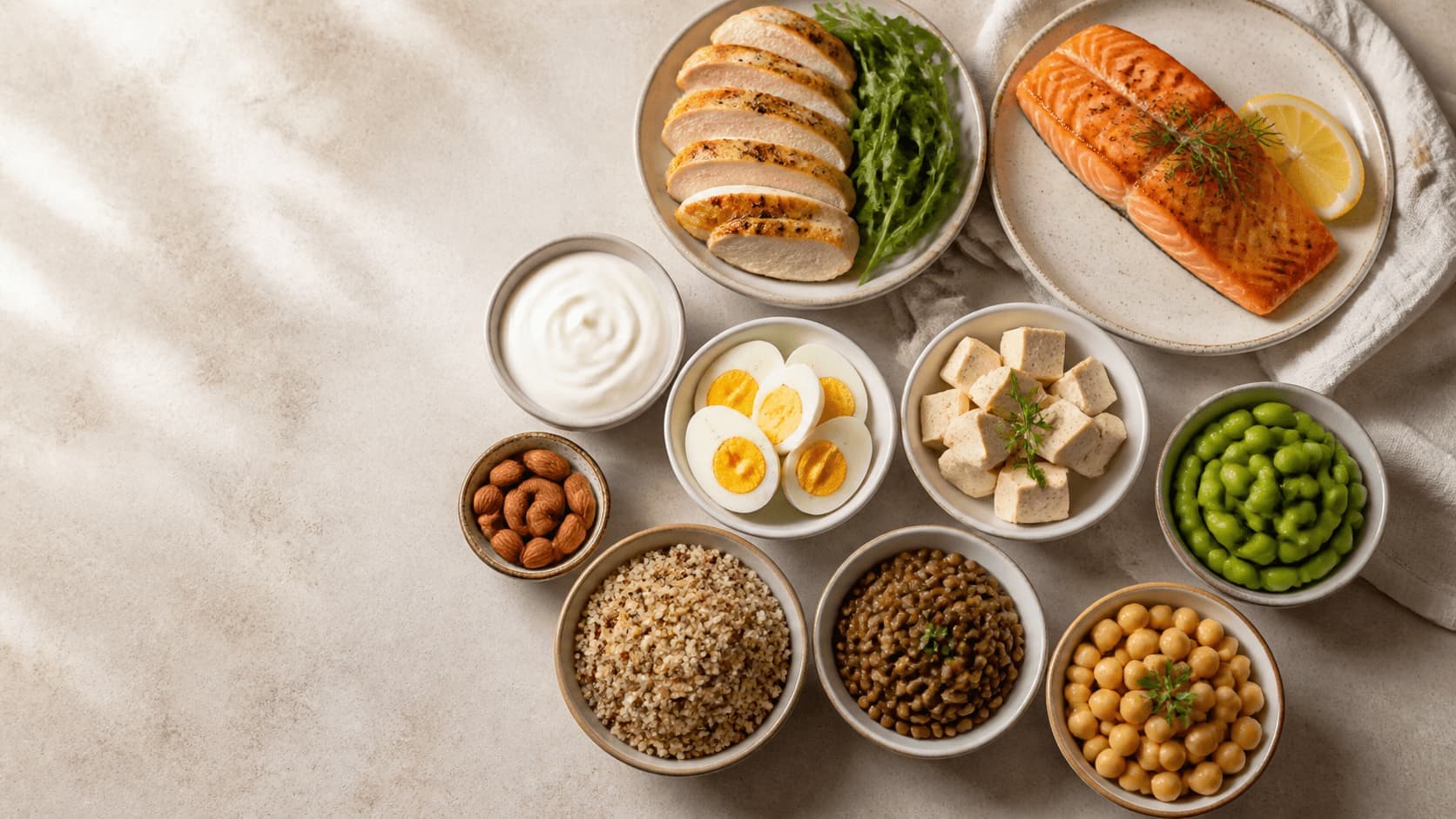
There is no single “best” protein food. Eggs, dairy, fish, meat, and poultry can all contribute. So can lentils, beans, chickpeas, tofu, tempeh, edamame, soy yogurt, seitan, nuts, seeds, and whole grains.
If you eat mostly or entirely plant-based, variety becomes especially useful. Build meals from more than one type of plant food over the day and make protein-rich staples easy to reach. A tofu stir-fry, lentil pasta with beans, or a grain-and-bean bowl can be a practical meal before anyone starts worrying about nutritional theory.
If a restrictive diet, digestive symptoms, allergies, or a medical condition makes food choices difficult, a qualified dietitian can help you make a plan that fits you.
Timing matters less than consistency
You do not need to eat at a magical minute after a workout or force a precise amount of protein into every meal. For most people, the more useful first step is meeting a suitable daily target consistently.
Once that is going well, spreading protein across the meals you normally eat can make the target easier to reach and may feel better than saving it all for late at night. Let your schedule, appetite, and training routine shape the details.
Let Kalorika handle the everyday arithmetic
A protein target only helps when it can live inside a real day. In Kalorika, logging the meals you actually eat shows how your protein is adding up alongside your remaining calories and macros. That makes a late lunch, a restaurant dinner, or a busy afternoon easier to navigate without guessing.
Coach can also use what you have already logged, the foods you enjoy, what is on hand, and the time you have to suggest a recipe or next meal that still fits your day. The aim is not to chase flawless entries. It is to make the next choice clearer.
Try a seven-day protein reset
Give yourself one ordinary week instead of starting a strict challenge.
- Choose a reasonable protein target based on your goal and starting point.
- Log the meals you actually eat for seven days, including imperfect days.
- Notice which meal most often leaves protein short.
- Pick two easy protein options that work for that moment of the day.
- Save or repeat meals that made the target feel easy, then review the week calmly.
At the end, ask a practical question: what is the smallest change that would make tomorrow easier? It might be keeping yogurt in the fridge, adding tofu to a usual meal, or asking Coach for a recipe that uses the food you already have.
Common questions
Do I need protein at every meal?
Not as a rigid rule. Including it in a few regular meals often makes a daily target easier to reach, but your day does not need to look perfectly even. Consistency over time matters more than making every plate identical.
Is protein powder necessary?
No. It can be a convenient food when it suits your budget and routine, but ordinary foods can provide protein too. Use a powder because it helps, not because you believe real meals no longer count.
Can I get enough protein on a vegan diet?
Yes, with varied, well-planned meals. Make protein-rich plant foods regular parts of your routine, rather than occasional extras. If you are unsure how to do that for your own needs, a qualified dietitian can help.
Do I need to track every gram perfectly?
The more consistently you log meals, the clearer picture Kalorika and Coach have of what your usual days look like. You do not need perfection for that to be useful. Honest entries give you better context for the next meal and the next plan review.
Can I simply keep increasing protein?
More is not automatically better. Very high targets are not guaranteed to improve results, and some health conditions require individual protein advice. Speak with a qualified health professional if you have kidney disease, have been told to limit protein, are pregnant or breastfeeding, or have a medical condition that affects your nutrition.
This article is for general education. It is not personal medical advice or a substitute for care from a qualified professional.