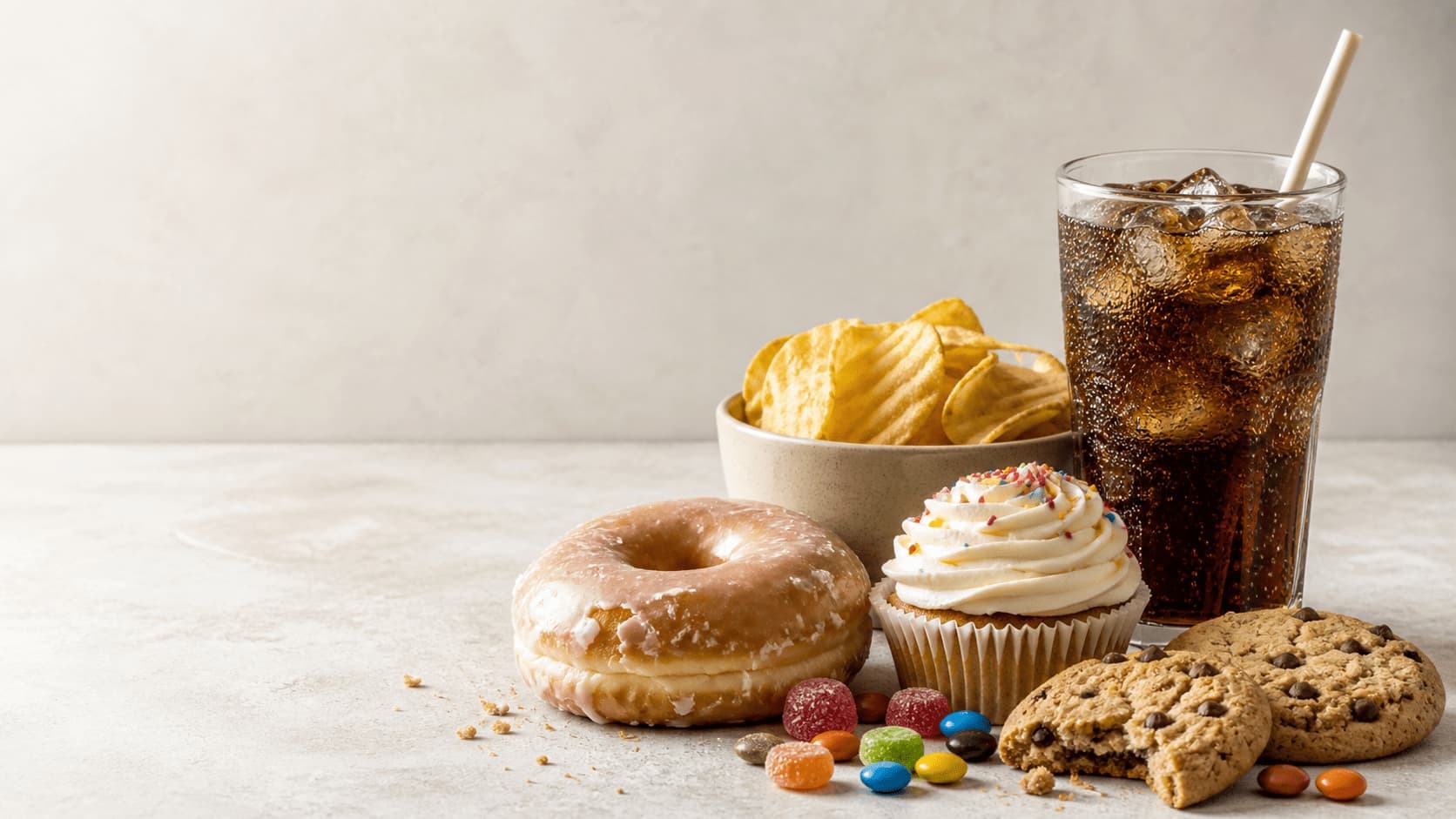
Calories tell you how much energy a food provides. They do not tell you everything else that comes with that energy. That is why the phrase “empty calories” is useful: it points to foods and drinks that provide energy but very little protein, fibre, vitamins, or minerals.
The phrase is informal, not a medical diagnosis. It also does not mean that one food is “good” or “bad”. A sweet snack can fit into a balanced diet. The useful question is what your overall pattern looks like and whether most of your meals give your body more than energy alone.
What does “empty calories” mean?
Empty calories usually come from added sugars, refined grains, solid fats, or alcohol. These ingredients can make a food or drink energy-dense while adding little fibre or micronutrients. A sugary drink is a simple example: it can add a meaningful amount of energy without making you feel as satisfied as a meal that also contains protein and fibre.
This is a relative description, not a perfect category. Olive oil, nuts, and dark chocolate contain calories, but they also bring other nutrients. Fruit contains natural sugar, but it also provides fibre, water, and micronutrients. Looking at the whole food is more useful than labelling one ingredient on its own.
The World Health Organization describes a healthy diet as varied and based largely on minimally processed and unprocessed foods, with limited free sugars, unhealthy fats, and sodium. That is the bigger idea behind the term: choose foods that contribute energy and useful nutrients most of the time.
Where do empty calories show up?
Some sources are easy to recognise. Others appear in normal routines because they are convenient, inexpensive, or easy to drink without noticing them.
- soft drinks, energy drinks, and sweetened coffees;
- sweets, biscuits, pastries, and many desserts;
- crisps and other snack foods that are high in energy but low in protein and fibre;
- white bread and other refined-grain foods when they make up most of a meal;
- alcoholic drinks, which provide energy but few essential nutrients.
None of these foods needs to disappear from your life. Frequency, portion size, and what you eat alongside them matter. A pastry with coffee is not the same as a pastry added to an already satisfying breakfast, and a drink with a meal is different from sipping sugary drinks all day.
Why calorie quality matters
Your body needs energy, but it also needs protein, fibre, vitamins, minerals, and fluids. Foods that provide several of these at once tend to make it easier to build satisfying meals and cover your nutritional needs.
Foods high in free sugars can take up part of your energy budget without adding much nutritional value. The WHO recommends keeping free sugars below 10% of total daily energy intake, with a further reduction below 5% offering additional benefits. Its guidance on free sugars explains what counts, including sugars added to food and drinks as well as those in honey, syrups, and fruit juice.
This does not mean that calories are unimportant. If your goal is weight loss, energy balance still matters. Food quality simply gives you another useful lens: a meal with protein and fibre may be easier to enjoy, repeat, and feel satisfied by than one made mostly from quickly eaten, low-fibre calories.
How to recognise empty calories in everyday life
You do not need to memorise a list of foods. Four quick questions are usually enough.
- Am I drinking these calories? Soft drinks, sweetened coffees, juices, and alcohol are easy to consume quickly. Check whether water, unsweetened tea, or another lower-sugar option would work just as well.
- What does the food add besides energy? Look for protein, fibre, fruit or vegetables, and useful fats. A food does not need all of them, but a meal usually benefits from more than one.
- What does the label say? Compare the serving size, sugar, fibre, protein, and salt. The ingredient list can also show whether sugar or refined flour is a main ingredient.
- What is the pattern, not just the single food? One snack rarely decides the quality of your diet. Notice what happens across a day or a week.
Nutrition labels are tools, not a moral score. The European Food Safety Authority explains that dietary reference values are scientific benchmarks for nutrients, not rules that make individual foods good or bad.
Simple swaps that add more nourishment
The easiest change is usually to add something useful rather than remove everything enjoyable. Try one small swap at a time:
| Instead of | Try | What changes | | --- | --- | --- | | A sugary drink | Water, sparkling water, or unsweetened tea | Less free sugar in the drink | | White toast with jam only | Whole-grain toast with yoghurt, eggs, or nut butter | More fibre and a protein or fat source | | Crisps as a stand-alone snack | Popcorn, fruit and yoghurt, or a small handful of nuts | More volume, fibre, or protein | | Dessert as the whole snack | Fruit with yoghurt, cottage cheese, or a few nuts | More texture and nutrients alongside sweetness | | A meal built mostly from refined grains | Add beans, lentils, eggs, tofu, fish, meat, or vegetables | More protein, fibre, and variety |
These are options, not upgrades you have to make every time. The NHS guide to a balanced diet recommends variety across the main food groups, including higher-fibre starchy foods, fruit and vegetables, protein foods, and small amounts of unsaturated fats.
Empty calories and weight loss
There is no special category of calories that automatically stops weight loss. A calorie is still a unit of energy, whether it comes from a biscuit or a bowl of lentils.
The practical difference is that meals with more protein, fibre, and volume may be easier to fit into a calorie target because they can be more satisfying. They also help you build a routine that is less dependent on constant snacking. You can still include chocolate, chips, or a favourite dessert. A sustainable plan makes room for enjoyment while giving most meals a solid nutritional base.
A simple way to improve your day
Look at one ordinary day of eating and choose the meal with the least staying power. Maybe breakfast is only coffee, lunch is mostly white bread, or the afternoon is built around sweet drinks.
Keep the part you enjoy and add one anchor:
- protein, such as yoghurt, eggs, beans, tofu, fish, or chicken;
- fibre, such as whole grains, fruit, vegetables, beans, or lentils;
- water or an unsweetened drink if liquid calories are adding up;
- a portion that feels satisfying instead of eating straight from the packet.
One useful addition is often easier to maintain than a complete reset. Over time, those small choices can make your meals more filling and your nutrition more varied without making food stressful.
Common questions about empty calories
Are empty calories unhealthy?
The term is not a clinical label, and no single food determines your health. Foods that provide mostly energy and few other nutrients are simply best treated as occasional parts of a varied diet rather than the foundation of most meals.
Are all processed foods empty calories?
No. Processing can make food safer, more convenient, or easier to store. Frozen vegetables, canned beans, pasteurised milk, and whole-grain bread are processed foods that can contribute useful nutrients. The question is what the food provides and how it fits into your overall diet.
Are sugar-free or “light” products always a better choice?
Not automatically. Fewer calories or less sugar does not guarantee more protein, fibre, vitamins, or minerals. Compare the whole product and choose the option that fits your taste, budget, and needs.
How many empty calories can I eat?
There is no universal daily limit for “empty calories”. The better target is a varied diet in which nutrient-rich foods make up most meals, while treats can fit in portions and frequencies that feel realistic for you.
This article is for general education. It is not personal medical advice. If you have a medical condition, a history of disordered eating, or specific dietary needs, speak with a qualified health professional.